Ship-From-Store Routing for Multi-Location Retailers
Shipping costs do not only come from carriers. They come from routing mistakes, split packages, unavailable store inventory, and orders sent to locations that were never the best place to fulfill them.
- Store-level inventory
- Customer distance
- Consolidation rules

Built for retailers using stores as fulfillment nodes
When every store can sell and ship inventory, the fulfillment decision becomes one of the most important margin decisions in the business.
Route smarter
Use store-level inventory, customer distance, and fulfillment rules.
Reduce splits
Consolidate shipments when a single package protects margin.
Print faster
Print labels and sync tracking without disconnected systems.
Keep flow clean
Keep ecommerce, marketplaces, POS, and stores in a cleaner order flow.
If your team is coordinating stores, ecommerce, marketplaces, and location-based fulfillment, see how Sqquid supports multi-location retailers.
Bad routing shows up as margin loss before it shows up as a system problem
An order ships from the wrong store. A package gets split. A store with limited staff receives too many orders. Inventory looks available online, but the location cannot actually fulfill it.
Geo-routing and order routing for multi-location fulfillment
Sqquid acts as an order routing engine that uses geo-routing, store availability, and fulfillment rules to help decide the best location for each order while protecting inventory accuracy, staff capacity, and shipment consolidation.
Which locations have the item and can fulfill it.
Which store or warehouse is best positioned for the customer.
Whether multiple items can ship together.
Priority, operational load, and carrier economics.
Ship-from-store without making store teams miserable
Ship-from-store works best when store employees do not have to become logistics experts.
- Orders are grouped by fulfillment location.
- Items are organized into shipments.
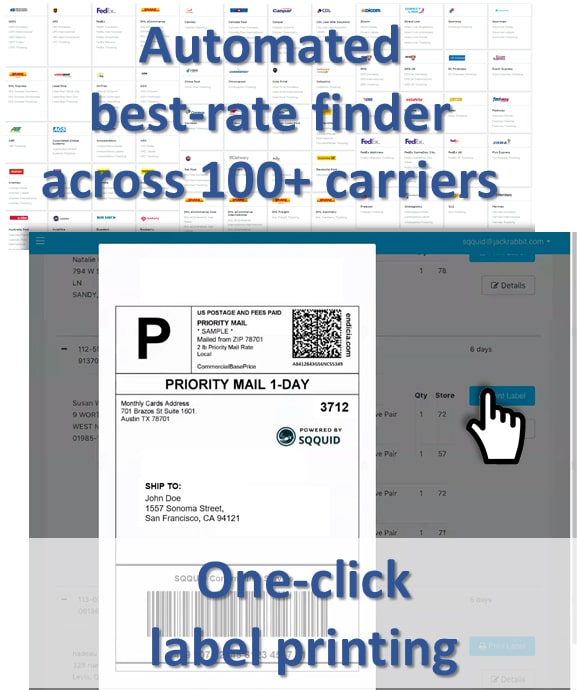
- Labels can be printed quickly.
- Tracking information is sent back to customers and connected systems.
- Holds, cancellations, and item location changes can be handled without starting over.
One-click shipping with rate shopping built in
RateFinder™ searches across 100+ carriers and helps staff find the lowest available shipping rate based on package details, destination, and delivery requirements.
Lower costs
Compare rates without sending staff across multiple tabs.
Carrier choice
Connect preferred carriers and existing shipping accounts.
Simple labels
Keep label printing practical for people doing the work.
Faster processing
Move quickly from routing decision to shipment.
Fulfillment should support channel growth, not block it
Google Shopping can increase traffic. Walmart and Amazon can increase order volume. TikTok Shop can create demand spikes. Shopify can become the ecommerce foundation for the whole operation.
Sqquid gives retailers the operational layer underneath channel expansion, so new revenue does not automatically create more oversells, routing mistakes, and support tickets.
For retailers working on feed quality and availability, see the Google Shopping integration. For catalog control, pair fulfillment routing with online merchandising.
What Sqquid helps coordinate
Orders
Sync ecommerce and marketplace orders into a cleaner fulfillment workflow.
Inventory
Use location-level availability as part of each fulfillment decision.
Locations
Treat stores, warehouses, and drop-ship locations as fulfillment nodes.
Shipping
Print labels, compare rates, and send tracking updates from one workflow.
Exceptions
Handle cancellations, holds, and location changes without messy side processes.

Built for real store-based fulfillment work
Read case study"Sqquid delivered not just an order processing system, but a sophisticated and flexible order logistics solution that helps us react faster to sales opportunities."
Common questions about fulfillment routing
A few practical definitions for teams comparing shipping automation, geo-routing, and order routing engines.
Map your fulfillment flow
Tell us your POS, ecommerce platform, sales channels, store count, and fulfillment pain points. We will help identify whether Sqquid is a fit for your current stack.