Retail Operations System
The retail operations system for inventory, orders, fulfillment, stores, warehouses, and channels
Sqquid helps growing retailers manage inventory, products, orders, marketplaces, stores, warehouses, and fulfillment from one practical operations layer.

What it is
What is a retail operations system?
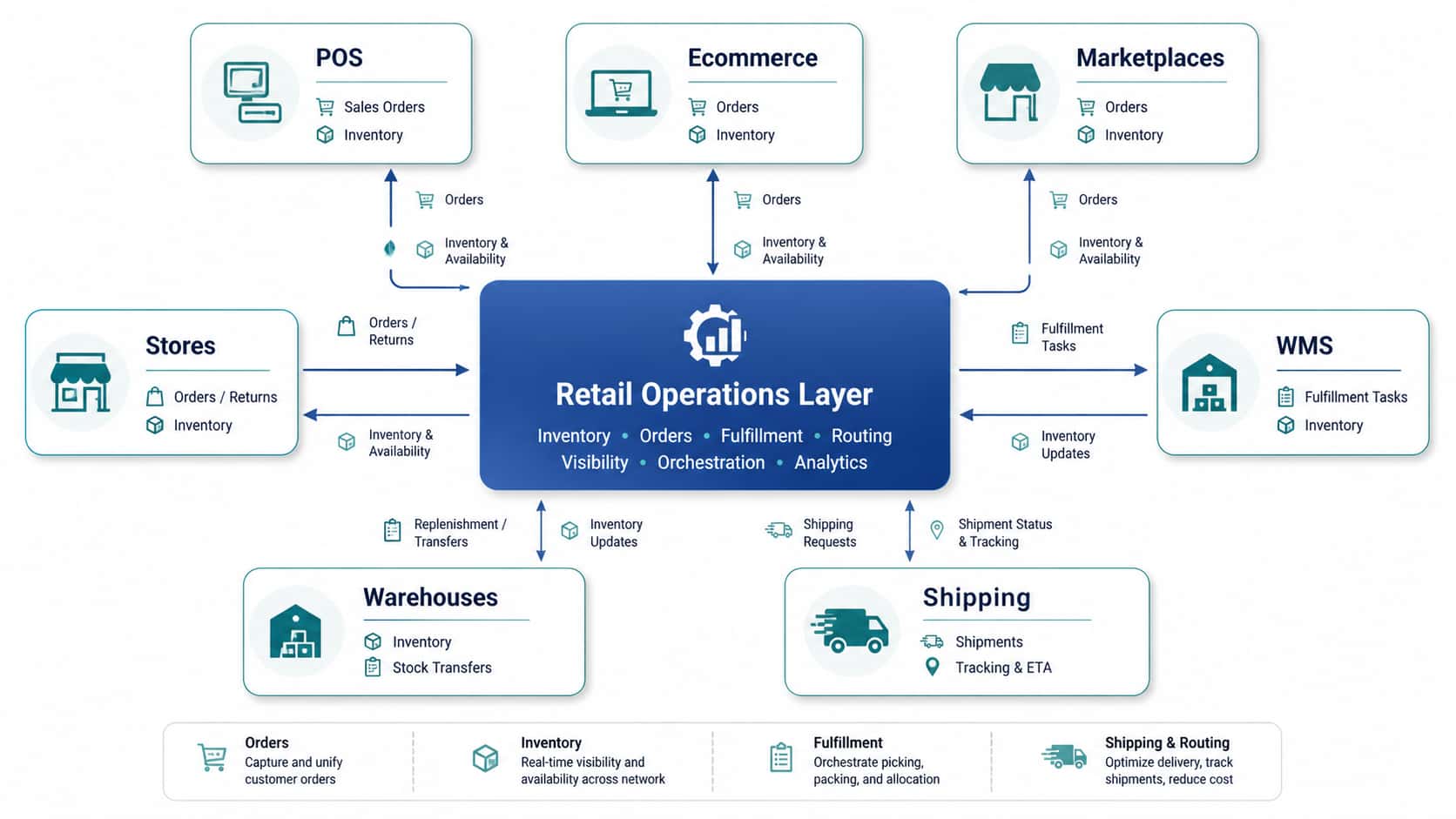
A retail operations system is the layer that sits between the systems a retailer already uses: POS, ecommerce, marketplaces, WMS, shipping, fulfillment, warehouses, stockrooms, and stores.
A connector moves data from one place to another. A retail operations system manages how that data should behave when the business becomes more complex. It coordinates inventory, product data, orders, routing, fulfillment, transfers, and channel activity so the retail stack works like one operation instead of a collection of disconnected tools.
The practical middle layer
Sqquid does not force retailers to replace every system. It gives the retail stack a stronger operations layer between the systems already running the business.
Why it matters
Why retailers outgrow basic connectors
Basic connectors work when there is one store, one ecommerce site, and one simple inventory flow. They start to break when growth adds stores, warehouses, marketplaces, pickup options, store transfers, and fulfillment rules.
The real problem is not that data needs to move. The problem is that each order, SKU, location, and channel starts creating operational decisions. Which location should fulfill? Which inventory should be published? Which product data should control each channel? Which exceptions need attention before customers are affected?

Inventory becomes unreliable
Store, ecommerce, warehouse, and marketplace inventory can drift out of sync, creating oversells, canceled orders, and poor customer experience.
Product data gets harder to control
Products, variants, images, attributes, prices, and channel mappings need more control than a basic POS-to-ecommerce sync can provide.
Orders need smarter routing
Every order becomes a decision across availability, distance, store priority, warehouse capacity, and fulfillment rules.
Fulfillment becomes a bottleneck
BOPIS, curbside pickup, ship-from-store, packing, shipping labels, transfers, and exceptions create workflows that simple sync apps do not manage.
Marketplaces add operational pressure
Walmart, TikTok Shop, Amazon, Google Shopping, Etsy, and eBay each add catalog rules, inventory expectations, order flows, and fulfillment demands.
Warehouses need structure
Many retailers do not need a full enterprise WMS, but they do need bins, picking, packing, transfers, and fulfillment-node visibility.
What Sqquid manages
One system for the messy middle of retail growth
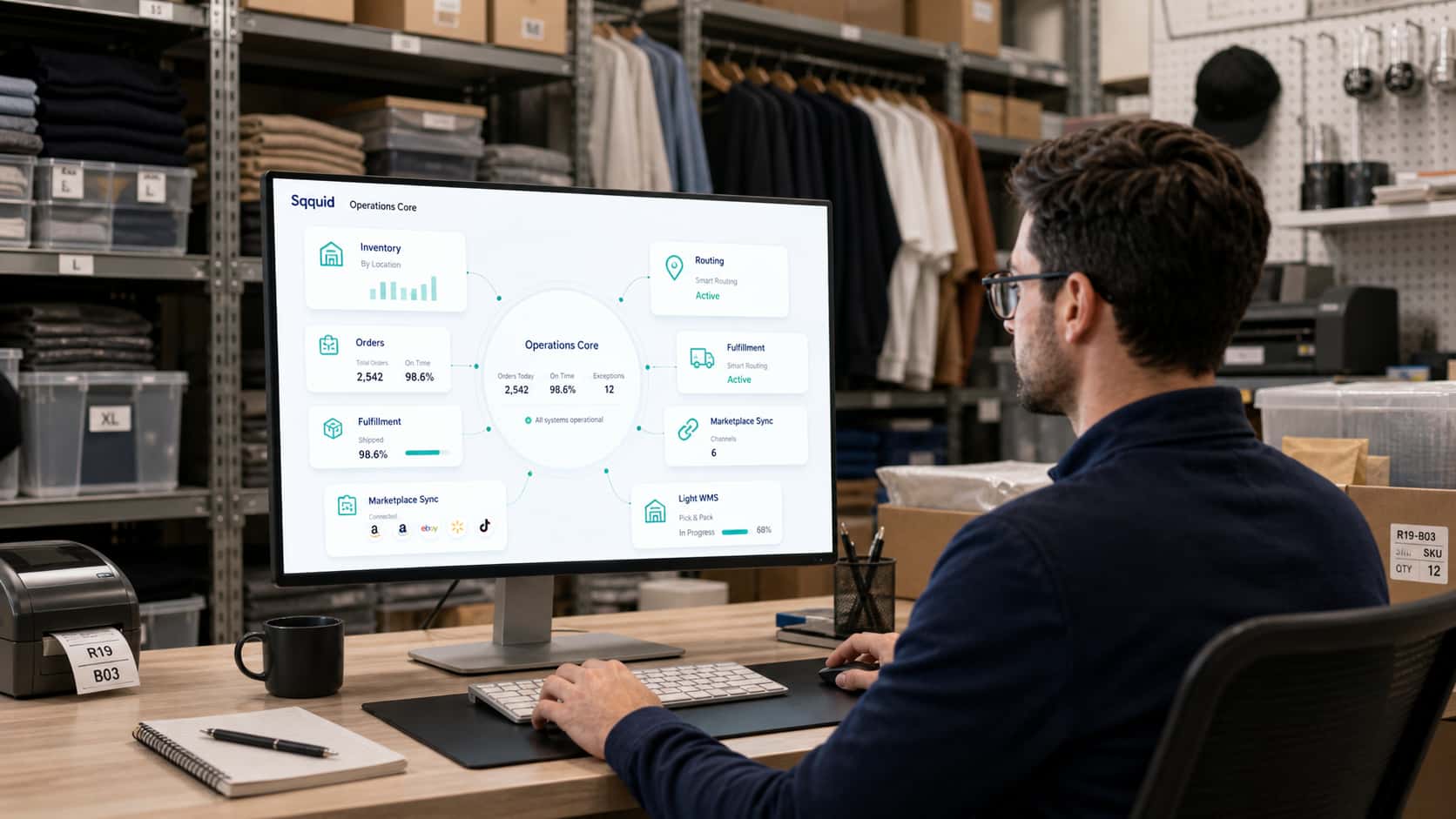
Sqquid manages the operational work that sits between POS, ecommerce, marketplaces, stores, warehouses, and fulfillment.
This is where growing retailers usually feel the pain: inventory needs to be accurate by location, products need to stay coordinated across channels, orders need to be routed correctly, and fulfillment teams need workflows they can actually run.
Inventory by location
Manage availability across stores, warehouses, stockrooms, and fulfillment nodes.
Product and variant data
Coordinate SKUs, variants, product fields, channel mappings, and catalog behavior.
Channel coordination
Keep ecommerce, marketplaces, shopping feeds, POS, WMS, ERP, and 3PL activity aligned.
Order management
Bring orders into one operational workflow with clearer status, exceptions, and fulfillment movement.
Order routing
Route orders based on inventory, location priority, proximity, fulfillment capacity, and business rules.
Fulfillment coordination
Support warehouse fulfillment, store fulfillment, pickup, packing, shipping updates, and exceptions.
Store transfers
Move inventory between stores, warehouses, and fulfillment nodes with better visibility.
Marketplace sync
Support channel expansion without letting every new marketplace create a new operational mess.
Light WMS workflows
Add practical bin/location, picking, packing, and warehouse workflows without forcing a heavy WMS rollout.
Who it is for
Built for retailers that need a real operations system before they scale further
Sqquid fits small and mid-size retailers selling physical products across stores, warehouses, ecommerce platforms, and marketplaces.
The best-fit retailer is not looking for another cheap connector. They need better control of inventory, orders, fulfillment, and channels before the next stage of growth makes operations harder to run.
Best-fit verticals
Scaling specialty retailers
2-20 location retailers that need stronger inventory, fulfillment, and channel operations before growing into more locations.
POS-frustrated retailers
Retailers whose POS works for in-store selling but is not strong enough as the central omnichannel operations layer.
Marketplace expansion retailers
Retailers adding Walmart, TikTok Shop, Amazon, Google Shopping, Etsy, or eBay without wanting oversells and fulfillment chaos.
Light WMS retailers
Retailers with stores, warehouses, bins, picking, packing, transfer workflows, and fulfillment-node needs.
Ecommerce-heavy inventory operators
Product businesses with serious SKU, warehouse, order, marketplace, and fulfillment complexity.
FAQ
Retail operations system FAQ
Is Sqquid just an integration connector?
No. Sqquid connects systems, but its stronger role is helping retailers manage the operational layer underneath inventory, product data, order routing, fulfillment, stores, warehouses, and marketplaces.
Does Sqquid replace my POS?
Usually no. Sqquid is designed to sit around the systems that already work, including POS systems, ecommerce platforms, marketplaces, WMS tools, shipping systems, and custom workflows.
Who is the best fit for Sqquid?
Sqquid is strongest for small and mid-size physical-product retailers with multi-location inventory, marketplace growth, ecommerce complexity, store fulfillment, warehouse workflows, or light WMS needs.
Is Sqquid only for multi-location retailers?
No. Sqquid is strongest for retailers with multiple stores, warehouses, fulfillment nodes, or marketplace channels, but the real fit is operational complexity. Ecommerce-heavy retailers with serious SKU, inventory, warehouse, or marketplace complexity can also be a strong fit.
Can Sqquid help with marketplace expansion?
Yes. Sqquid helps retailers add channels like Walmart Marketplace, TikTok Shop, Amazon, Google Shopping, Etsy, and eBay with more control over inventory, catalog behavior, orders, routing, and fulfillment.
Ready to map your workflow?
See where your retail stack is creating operational drag.
Sqquid can help you map how inventory, orders, products, fulfillment, stores, warehouses, and channels should work together before you add more complexity.