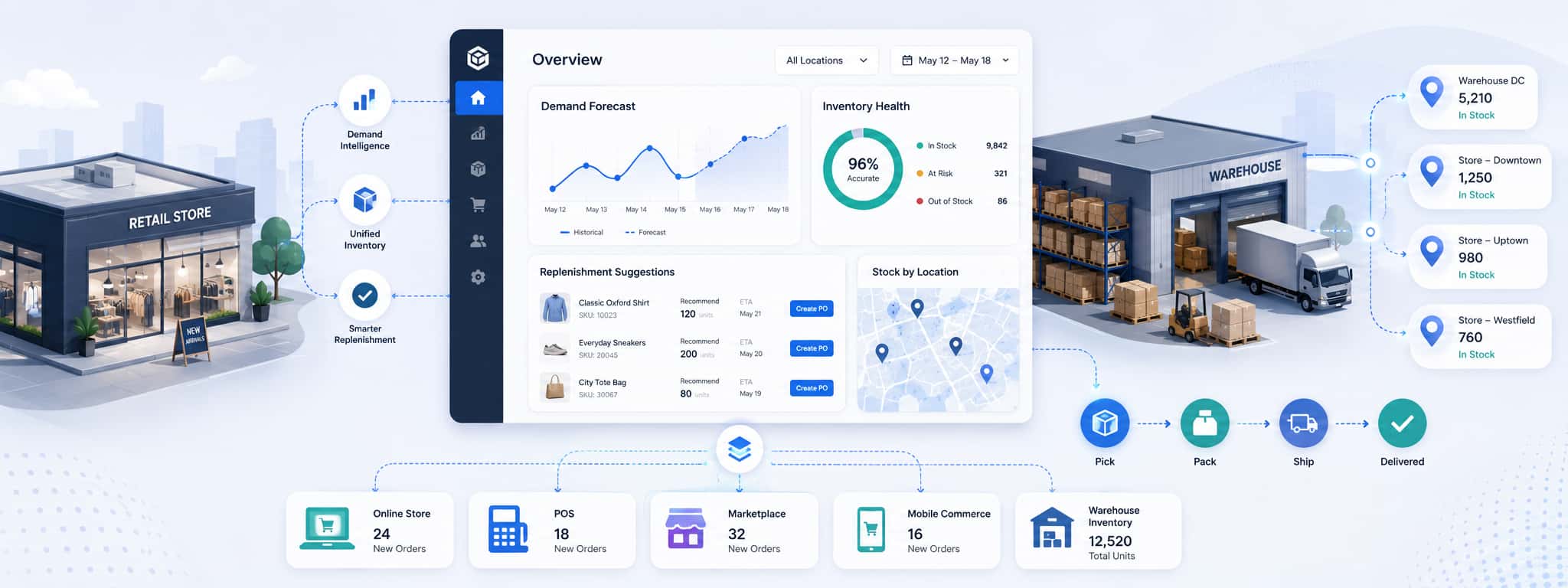
Predictive inventory optimization sounds simple from a distance.
Forecast demand. Buy the right amount. Avoid stockouts. Avoid overstock. Improve margin.
That is the promise. But for real retailers, the operational reality is usually messier.
The retailer has stores. A warehouse. Maybe two warehouses. A POS system. Shopify. Marketplace channels. Shopping feeds. Store transfers. Returns. BOPIS. Ship-from-store. Manual adjustments. Vendor delays. Duplicate SKUs. Products that sell differently by location. Products that spike on TikTok. Products that quietly die on the shelf.
That is why predictive inventory optimization cannot be treated as a magic forecasting dashboard. It has to be built on top of trustworthy inventory, order, product, channel, and fulfillment operations.
For growing retailers, the first question is not, “Can AI predict demand?”
The better question is:
Is your retail operation accurate enough for predictions to be useful?
Predictive inventory optimization is more than demand forecasting
Demand forecasting predicts what customers may buy. Predictive inventory optimization uses that forecast, plus operational data, to help decide what the retailer should do next.
That difference matters.
A forecast may say a product will sell 40 units next week. But a retailer still needs to answer practical questions:
- Which location needs inventory?
- Which warehouse should replenish it?
- Should inventory be moved from a slow store to a fast store?
- Should more stock be exposed on Shopify or held back for in-store demand?
- Should marketplace availability be limited to prevent oversells?
- Is the item actually available, or does the system only think it is?
- Is the product a true stockout risk, or just poorly allocated?
- Is the product dead stock, or does it need a better channel?
This is where real inventory optimization begins.
Netstock describes predictive inventory management as using historical sales, market trends, customer behavior, seasonal patterns, and external factors to make smarter inventory decisions, while also noting that these systems depend on reliable and accurate data. That data requirement is the part many retailers underestimate. A forecast built on bad inventory data can make the business confidently wrong. See Netstock’s overview of predictive inventory management for a useful framing of how forecasting and data quality work together.
The messy middle of modern retail
Most inventory software talks as if every retailer has one clean system of record.
Real retailers often do not.
They may have a POS that is good for selling in stores but weak as the central inventory layer. They may have Shopify as the ecommerce hub, but Shopify is not the only place orders happen. They may have marketplace channels like Walmart, Amazon, TikTok Shop, Google Shopping, Etsy, or eBay. They may have a warehouse process that still depends on spreadsheets, manual picks, or partial WMS workflows.
That creates the messy middle of retail operations.
Inventory is not just counted. It is promised, reserved, transferred, routed, picked, packed, adjusted, returned, and exposed to multiple channels.
That is why retailers often outgrow basic connectors. A connector moves data. A real retail operations system helps decide how inventory, products, orders, fulfillment, stores, warehouses, and channels should work together.
The difference becomes obvious when something goes wrong.
A product shows five units available in a store. Shopify publishes the item. A marketplace order comes in. The POS has not synced the latest store sale. One unit is damaged. One unit is on display. Two units are sitting in a transfer that has not been received. The system says five. The store can actually fulfill one.
That is not just a forecasting problem.
That is an operational truth problem.
Why inventory accuracy comes before prediction
Predictive inventory optimization depends on inventory accuracy, but not only in the classic accounting sense.
Traditional inventory accuracy asks whether the quantity in the system matches the quantity on the shelf.
Modern omnichannel inventory accuracy also asks whether the available inventory shown to customers is truly sellable.
Those are not always the same thing.
A store may physically have inventory that should not be exposed online. A warehouse may have inventory that is already reserved for other orders. A marketplace listing may still be live because an update is delayed. A POS may be technically accurate at the register but not reliable enough for real-time ecommerce selling.
Shopify’s inventory management guide notes that retailers use inventory tools to track sales, forecast demand, set low-stock alerts, create purchase orders, and manage warehouse and store inventory. Those are important capabilities, but they become much more valuable when they are connected to the operational flows that determine whether inventory can actually be sold, picked, routed, and fulfilled. See Shopify’s guide to inventory management for a broader view of the inventory management workflow.
For a real retailer, predictive inventory optimization should be built on these foundations:
- accurate inventory by location
- clean product and variant data
- reliable POS, ecommerce, and marketplace sync
- realistic available-to-promise logic
- store and warehouse fulfillment rules
- transfer visibility
- order routing logic
- exception tracking
- replenishment and allocation signals
Without that foundation, forecasting becomes a layer of math on top of operational noise.
The AI trap: predicting demand does not fix broken operations
AI can help retailers. But AI does not automatically fix inventory operations.
A recent example is a useful warning. Reuters reported that Starbucks scrapped an AI-based inventory counting tool across North America after the system had persistent inaccuracies in item identification. The lesson is not that AI is useless. The lesson is that inventory automation has to work inside real store conditions, real workflows, and real exception patterns. See the Reuters report on Starbucks scrapping its AI inventory tool.
Retailers should be skeptical of any system that jumps straight to “AI optimization” without first asking operational questions:
- Which system owns inventory truth?
- How often does inventory sync?
- What happens when POS, Shopify, and marketplace quantities disagree?
- How are low-stock items protected from overselling?
- What inventory should be excluded from online availability?
- How are transfers handled?
- How are damaged, display, reserved, or pending units handled?
- How are orders routed when more than one location can fulfill?
- How are store teams alerted when inventory exceptions happen?
Prediction is powerful only when the business can act on it.
If the recommendation is “reorder 20 units,” but the inventory count is wrong, the lead time is outdated, the store demand is hidden, and marketplace availability is uncontrolled, the recommendation may create more problems than it solves.
What predictive inventory optimization should actually do
For real retailers, predictive inventory optimization should not be a single chart.
It should be a practical decision layer that helps teams identify risk, prioritize action, and protect margin.
1. Identify stockout risk before customers feel it
A stockout is not just an empty shelf. It is a missed sale, a disappointed shopper, a canceled order, or a marketplace performance problem.
Predictive inventory optimization should flag products at risk based on:
- current available inventory
- sales velocity
- location-level demand
- pending orders
- supplier lead time
- seasonality
- marketplace exposure
- replenishment timing
- open purchase orders
- transfer availability
The key is that stockout risk should not be calculated only at the company-wide level.
A product may be healthy overall but at risk in the store that actually needs it. Another product may look low in one warehouse but have plenty of units trapped in slow-moving locations.
For multi-location retailers, the location matters as much as the SKU.
2. Identify dead stock before it becomes margin damage
Dead stock is not always obvious early.
A product may still be “active” in the system while quietly losing velocity. A style may be selling in one store but dying in another. A product may be slow on Shopify but still viable on a marketplace. Another item may need a transfer, not a markdown.
Predictive inventory optimization should help retailers separate:
- true dead stock
- slow-moving but seasonal inventory
- misallocated inventory
- inventory that needs a new channel
- inventory that should be transferred
- inventory that should be promoted
- inventory that should be reordered carefully, not aggressively
This protects gross margin because the retailer can act before markdowns become the only option.
3. Recommend replenishment with operational context
A reorder recommendation should not be based only on historical sales.
It should consider where the inventory is, where demand is forming, and how long replenishment will take.
A practical replenishment recommendation should answer:
- What should we reorder?
- How many units should we reorder?
- Which location needs the inventory?
- Is there enough inventory elsewhere to transfer first?
- Is the supplier lead time changing?
- Is the item exposed to channels that could create sudden demand?
- Should safety stock be adjusted?
- Should availability be limited until replenishment arrives?
This is where predictive inventory optimization becomes useful to operators, not just analysts.
4. Recommend transfers before buying more inventory
Retailers often buy too soon because they cannot clearly see where inventory is stuck.
A product may be “out” online while units sit in a slow store. Another store may reorder while a nearby location has too much. A warehouse may buy more because store inventory is not trusted enough to use for fulfillment.
A good predictive system should recommend inventory movement before new purchasing when appropriate.
That may include:
- store-to-store transfers
- warehouse-to-store replenishment
- store-to-warehouse consolidation
- moving slow inventory into ecommerce fulfillment
- reserving certain units for local demand
- changing which location exposes inventory online
Transfer intelligence is especially important for retailers using stores as fulfillment nodes. Inventory optimization is not only about how much to buy. It is also about where inventory should sit.
5. Connect inventory risk to order routing
Inventory optimization and fulfillment should not be separated.
If an order can ship from five locations, the system should not choose blindly. It should consider inventory depth, customer distance, store capacity, split shipment risk, and the future value of keeping inventory in certain locations.
For example, the closest store may not always be the best fulfillment node if it has the last unit of a fast-selling local item. Another location may be slightly farther away but better positioned to fulfill without hurting local store demand.
This is why shipping and fulfillment logic matters inside predictive inventory optimization. Routing decisions affect inventory health. Inventory health affects routing decisions.
The systems need to talk to each other.
The practical dashboard retailers actually need
A useful predictive inventory dashboard should not overwhelm the team with dozens of charts.
It should make the next best action obvious.
For a growing retailer, the dashboard should surface:
- top stockout risks
- top dead stock risks
- products with fast-changing velocity
- locations with repeated inventory drift
- SKUs causing oversells or cancelations
- replenishment suggestions
- transfer suggestions
- items with risky marketplace exposure
- low-stock products with long lead times
- products that should be protected with safety stock
- orders affected by inventory exceptions
The most valuable dashboard is not the prettiest one. It is the one that changes what the team does today.
If the operations manager opens the dashboard and immediately knows what to fix, transfer, reorder, protect, or investigate, the system is doing its job.
What retailers should fix before adding predictive optimization
Before investing in advanced inventory optimization, retailers should review their operational foundation.
Start with these questions:
Do we trust location-level inventory?
If store inventory is frequently wrong, predictive recommendations will be unreliable. Fix high-risk locations, fast-moving products, and repeated adjustment patterns first.
Do we know what inventory is truly available to sell?
Raw on-hand inventory is not always available inventory. Display units, damaged items, pending orders, reserved stock, transfer inventory, and safety buffers need to be handled clearly.
Do our systems sync quickly enough?
Slow sync creates oversell windows. As channels expand, those windows become more dangerous.
Are products and variants mapped cleanly?
Bad SKU mapping creates inventory errors that look like stock problems but start as catalog problems.
Are routing rules protecting inventory health?
If every order simply goes to the closest location or default warehouse, the retailer may be creating new stockout problems while fulfilling today’s orders.
Are marketplaces controlled carefully?
Marketplaces can create demand quickly. That is good when inventory is accurate and fulfillment is ready. It is dangerous when availability is loose and exception handling is manual.
The future: practical prediction, not magic prediction
The future of inventory optimization is not one giant AI button.
The future is practical prediction embedded into daily retail operations.
That means:
- warning teams before stockouts happen
- identifying dead stock early
- recommending transfers before reorders
- adjusting replenishment based on channel demand
- protecting store-level inventory from oversells
- routing orders in ways that preserve margin
- helping retailers add new channels without operational chaos
For real retailers, predictive inventory optimization has to respect reality. Stores are not warehouses. Warehouses are not websites. Shopify is not the POS. Marketplaces are not all the same. Inventory is not just a number. Fulfillment is not just shipping.
Everything is connected.
The retailers that win will not be the ones with the flashiest forecast. They will be the ones with the cleanest operating layer underneath the forecast.
About Sqquid
Sqquid helps growing retailers manage inventory, products, orders, marketplaces, stores, warehouses, and fulfillment from one practical retail operations system. Sqquid is built for small and mid-size retailers that are outgrowing brittle connectors, struggling with inventory accuracy, expanding into channels like Shopify, Walmart, TikTok Shop, Amazon, Google Shopping, and Etsy, or trying to support BOPIS, ship-from-store, order routing, and multi-location fulfillment without creating operational chaos. If your team needs cleaner inventory control and a stronger operations layer before adding more channels or more complexity, Schedule a demo with Sqquid.